


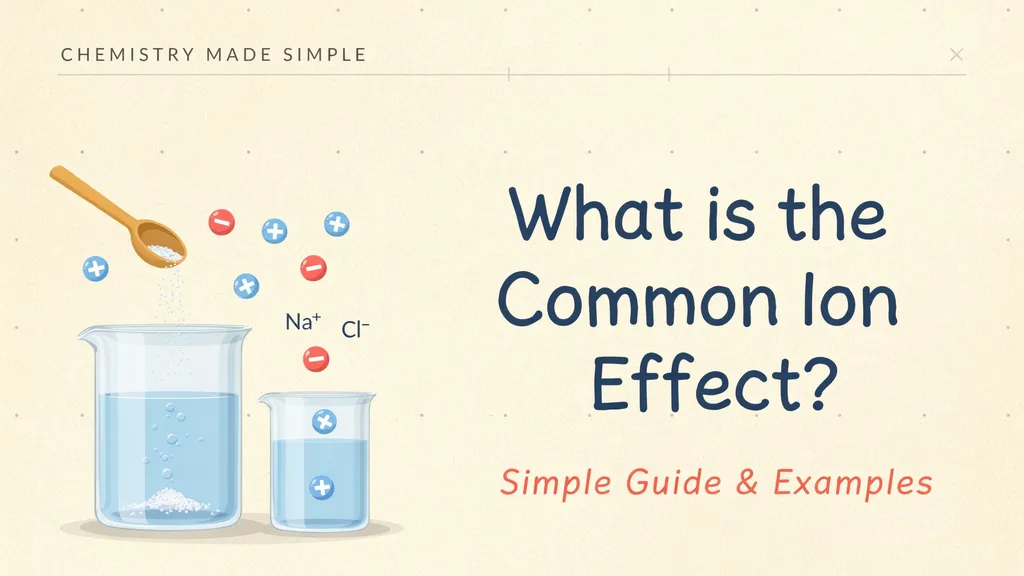
Have you ever added too much salt to a pot of soup and watched it change the whole taste? Chemistry has a funny way of working just like that! When we talk about how chemicals mix in water, things do not always act alone. Sometimes, adding a tiny bit of something extra can change how other things dissolve. This cool science trick is known as the Common Ion Effect. It happens all the time in science labs and even inside nature. If you want to understand how chemical balance works without getting stuck on boring rules, you are in the right place. We are going to break down this big science idea using super simple words and fun examples. By the end of this guide, you will be a pro at seeing how sharing the same tiny particles changes everything in a liquid mix. Grab a comfy seat, and let us dive right into the amazing world of chemistry together!
What Is the Common Ion Effect?
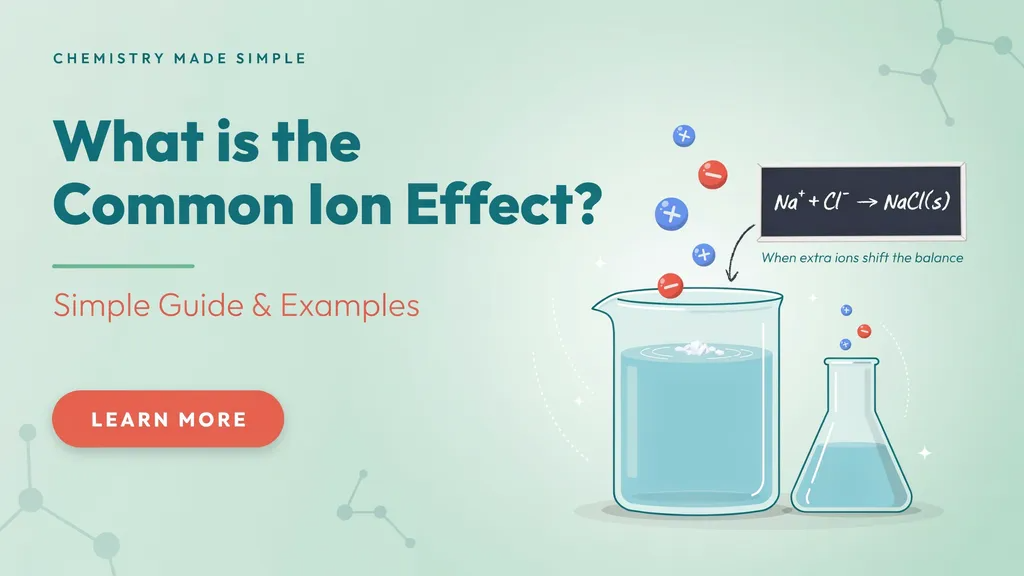
At its heart, the common ion effect is all about how certain chemicals share tiny charged particles called ions. Imagine you have a cup of water with a dissolved solid, and it is holding as much as it possibly can. This is what scientists call a saturated solution. Now, imagine you drop in a brand new chemical that happens to share one of those exact same ions. Because the liquid already has plenty of that specific particle floating around, it pushes the original solid back out! It is almost like a crowded room where nobody else can fit inside because the doorway is already blocked. This neat rule is a direct result of Le Chatelier’s principle, which simply means a balanced system will always try to shift itself to fix a sudden change. Understanding this helps us see why some solids fall to the bottom of a test tube instead of disappearing into the liquid. It is a fundamental building block for learning how chemical reactions stay in balance.
How Solubility Gets Lower
When we look closely at solubility, the common ion effect plays a huge role in making things less soluble. Solubility is just a fancy word for how well a solid can melt away and dissolve inside a liquid. Normally, a specific amount of salt or powder will vanish into water until the liquid is totally full. But if you introduce a second salt that brings in a duplicate ion, the first salt suddenly refuses to dissolve as much. The extra ions hanging out in the water act like an invisible wall. They force the dissolved bits back together to form solid pieces once again. This drop in solubility is something chemists rely on every single day to clean up mixtures and pull pure substances out of a liquid. It proves that tiny invisible particles can have a massive impact on the physical world around us. Watching this happen in a lab beaker feels a bit like magic, even though it is pure science at work.
Le Chatelier’s Principle Explained
To truly get a grip on the common ion effect, we have to talk about a smart rule named after a French chemist named Le Chatelier. Think of a seesaw on a playground. If a heavy friend jumps onto one side, the seesaw dips down, and the other side flies straight up into the air. Chemical balance acts in the exact same way. Whenever you upset a calm chemical mixture by adding extra ions, the mixture tries its best to balance things back out. If you pump up the amount of product on one side of the equation, the reaction shifts in reverse to use up that extra stuff. This constant pushing and pulling keeps chemical systems stable even when we mess with them. It is one of the most reliable rules in all of science because it helps us predict what a liquid will do before we even mix it.
A Quick Look at Chemical Balance
Chemical balance, or equilibrium, is the secret engine behind the common ion effect. Picture a busy restaurant door where the exact same number of people walk inside as the number of people walking back outside. Inside the room, the total head count stays completely steady even though everyone is moving around. That is exactly what happens in a chemical reaction when it reaches equilibrium. The forward process and the reverse process happen at the exact same speed. However, the common ion effect comes along and disrupts this peaceful party. By tossing in extra shared ions, you suddenly throw off that steady head count at the door. The system has to scramble and adjust its speed to find a brand new resting point. This constant dance between balance and disruption is what makes chemistry such a fun puzzle to figure out.
Real Life Example: Table Salt and Soap
You might not realize it, but the common ion effect pops up in places you visit every single day, like your bathroom or kitchen. Take soap making, for instance! When soap makers want to separate pure soap from leftover liquid, they pour regular table salt right into the mix. Table salt breaks apart into sodium ions and chloride ions in the water. Because the soap mixture already contains sodium, those extra sodium ions trigger the common ion effect. This sudden crowd of sodium forces the soap molecules to clump together and float right to the top of the container. It is a clever, natural trick that lets workers scoop out clean soap bars easily. Next time you wash your hands, you can thank this neat chemical reaction for keeping your soap solid and ready to use!
The Math Behind the Magic
Even though science can sound intimidating with numbers, the math behind the common ion effect is actually quite straightforward. Scientists use something called a solubility product constant to measure how much solid can dissolve in water. When you introduce a shared ion, you have to plug that extra number into your math equation. Because the concentration of the common ion goes way up, the math forces the other matching value to go down. This guarantees that the final calculation always stays balanced. Doing these quick math steps helps students and researchers figure out exact measurements before they even touch a beaker. It takes the guesswork out of experiments and lets us plan out chemical reactions with total confidence. Once you practice a couple of simple equations, you will see that the numbers always tell a very clear story.
Why Chemists Care So Much
You might wonder why scientists care so deeply about the common ion effect in their everyday work. The truth is, this single concept is a powerhouse tool for purifying medicines and testing drinking water. Chemists often need to pull dangerous metal pollutants out of liquid waste before it goes back into nature. By carefully adding specific salts, they use the common ion effect to trap those bad metals and turn them into solid sludge at the bottom. Once the bad stuff turns solid, it is super easy to filter out and throw away safely. This keeps our rivers clean and ensures our medicine is pure and safe to swallow. It is amazing to think that a basic rule about sharing tiny particles can protect our health and our planet in such a huge way.
| Feature/Concept | How It Works | Real-World Application |
| Solubility | Measures how well a solid dissolves in a liquid until it cannot hold any more. | Mixing drink powder into a glass of cold water. |
| Common Ion Effect | Decreases solubility by adding extra shared ions to a balanced solution. | Making and separating solid soap bars from liquid mixtures. |
| Le Chatelier’s Principle | Shifts a balanced system to fix a sudden change or added pressure. | Regulating body fluids and chemical balance in nature. |
| Equilibrium | A steady state where forward and reverse chemical reactions happen equally. | Industrial chemical plants producing safe everyday products. |
Common Mistakes to Avoid
When students first start learning about the common ion effect, it is super easy to make a few silly mistakes. One common slip-up is forgetting to include the extra ion’s starting amount in your final math calculations. People often assume the water starts completely empty, but the shared ion brings its own heavy weight to the table right from the start. Another mistake is thinking that any random chemical will cause a reaction. Remember, the added chemical must share an exact duplicate ion with the original solid for the trick to work. If the ions do not match, nothing special happens at all! Keeping these small details in mind will save you a lot of time and frustration during your science homework or lab experiments.
Conclusion
We have taken a fantastic journey exploring the wonderful world of the common ion effect today! From understanding how tiny shared particles crowd a liquid, to seeing how soap makers use table salt in real life, science proves to be full of fun surprises. Remembering simple rules like Le Chatelier’s principle helps make sense of why chemicals shift, balance, and separate. Next time you mix powders in water or wash your hands with soap, try to picture the invisible atoms doing their speedy dance. Science is not just a bunch of boring rules in a heavy textbook; it is the active magic happening all around us every single day. We hope this guide inspired your curiosity and made chemistry feel a little bit friendlier. What other cool science questions are you hoping to explore next?
Frequently Asked Questions
What is the simple definition of the common ion effect?
It is a science rule where adding a chemical with a shared ion forces a dissolved solid to come out of a liquid and turn solid again.
Does the common ion effect increase or decrease solubility?
It always decreases solubility. The extra shared ions crowd the liquid and make it harder for more solid to dissolve.
Can you give a daily life example of this effect?
Yes! Adding table salt to a soapy liquid mix forces the soap molecules to clump together and separate so people can collect pure soap.
Why do scientists use this rule in laboratories?
Scientists use it to purify chemicals, clean up polluted water, and remove unwanted metal waste safely and quickly.
Does this effect break any chemical laws?
No, it actually proves Le Chatelier’s principle, which shows how balanced systems react when something new is added.
Do I need advanced math to understand it?
Not at all! Basic multiplication and keeping track of ion amounts are usually all you need to solve simple problems.
